TL;DR
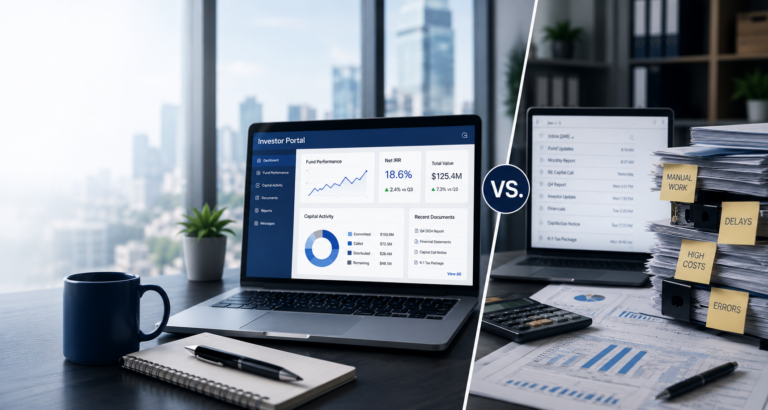
- Firms moving from email and Excel based reporting to a portal have reported inbound LP query volume dropping more than 60% within the first quarter.
- A firm managing 60 LPs across two funds can expect 80 to 120 inbound document requests a year on manual reporting. Self-service access removes most of that volume.
- Quarterly reporting cycles that once took close to three weeks of manual file matching have been compressed to roughly a single morning’s work once the portal connects directly to fund administrator data.
- Most of the measurable ROI shows up within the first one to two quarters. It comes from time saved, not from a single dramatic event.
Every GP evaluating an investor portal asks a version of the same question before signing off on budget: how long until this actually pays for itself. It is a fair question, and it deserves a real timeline, not a vague promise of efficiency gains. The honest answer is that most of the measurable return shows up faster than firms expect, within the first one to two quarters, and it shows up as time saved rather than as one dramatic event.
That matters because portal ROI gets pitched inconsistently across the market. Some vendors lean on long term fundraising advantages that are real but hard to quantify in a budget meeting. Others promise instant transformation that doesn’t survive contact with an actual implementation. The realistic picture sits in between: a short setup period, a fast first payback in reduced LP query volume, and compounding gains from there.
Where the ROI Actually Comes From
Portal ROI breaks down into a small number of measurable categories. Each one is concrete enough to model against your own LP count and current reporting process.
1. Fewer inbound LP queries
When LPs cannot self-serve a document, they call or email the IR team, and that adds up. A firm managing 60 LPs across two funds can expect 80 to 120 inbound document requests a year under manual reporting. Firms that have moved to portal based self-service have reported inbound LP query volume dropping more than 60% in the first quarter alone. That is the single fastest, most measurable line item in the ROI case.
2. Faster reporting cycles
Manual quarterly reporting typically involves matching files across fund administrators, verifying side letter terms in a separate spreadsheet, and assembling statements by hand. One mid-market private credit firm compressed a reporting cycle that previously took close to three weeks down to roughly a single morning’s work once the portal connected directly to fund administrator data. That time returns to the IR team every single quarter, not just once.
3. Fewer errors and less rework
A single formula error in a shared spreadsheet can propagate across dozens of LP statements before anyone catches it, typically when an LP calls to question a figure. Automated, system of record connected reporting removes the manual re-keying step where most of these errors originate, along with the rework cycle that follows each one.
4. Reduced fundraising friction
Institutional LPs increasingly run technology due diligence on prospective managers before committing capital. A firm still running LP communications through email and shared drives signals operational risk before the first meeting even happens. A modern portal removes that friction point during the next raise, which is a real return even though it is harder to put a single number on.
See What Your Firm’s Portal ROI Could Look Like
Vantage builds a cost model around your specific LP count, fund structure, and current reporting workflow, so you can see the realistic payback timeline before you commit to anything.
→ Book a Vantage ROI Walkthrough
A Realistic Time to Value Timeline
The table below reflects how ROI typically unfolds for a mid-sized PE firm implementing a portal connected directly to its fund accounting system of record.
| Timeframe | What Typically Happens | Where the Value Shows Up |
|---|---|---|
| Weeks 1 to 4 | Portal connects to the fund accounting system of record. LPs are migrated and given access. Document backlog is loaded. | Minimal visible ROI yet. This is setup, not payback. |
| Quarter 1 | First full reporting cycle runs through the portal. LPs begin self-serving K-1s, capital account statements, and quarterly reports. | Inbound LP query volume drops, often by more than half, as documented in firms moving off email based reporting. |
| Quarter 2 | Reporting cycle time compresses as manual file matching and side letter verification are replaced by direct data connections. | A reporting cycle that took close to three weeks can shrink to roughly a single morning’s work. |
| Quarter 3 and beyond | IR team shifts time from document fulfillment to LP relationship work. Onboarding for new LPs runs through the same platform. | Recurring time savings compound. The business case shifts from cost avoidance to a fundraising and retention advantage. |
What Slows Down ROI
- A portal that sits on top of manually exported data instead of connecting to the system of record. Every export is a place for errors and delay to creep back in.
- LP migration handled informally instead of as a defined onboarding step. LPs who never activate their accounts keep calling the old way.
- No internal owner for the rollout. Someone on the IR or fund operations team needs to drive adoption in the first quarter, or usage stalls.
- Treating the portal as a document dump rather than configuring dashboards and KPIs that answer the questions LPs actually ask.
The GP Takeaway
The business case for an investor portal does not require betting on a distant, hard to prove benefit. The first payback, fewer inbound LP queries and a faster reporting cycle, is measurable within a quarter or two using numbers a firm already has: current LP count, current request volume, and current reporting cycle time. The longer term gains in fundraising positioning and IR capacity build on top of that early return rather than replacing it.
Vantage connects directly to your fund accounting system of record, so LPs get self-service access from day one and your team sees reduced query volume and faster reporting cycles within the first full quarter, not a year down the road.
Frequently Asked Questions
How long does it take to see ROI from an investor portal?
Most firms see measurable returns within one to two quarters. Setup and LP migration happen in the first several weeks, the first full reporting cycle in quarter one typically shows a meaningful drop in inbound LP queries, and reporting cycle time compression follows in quarter two as the portal connects fully to fund administrator data.
How much can an investor portal reduce inbound LP requests?
Firms moving from email and spreadsheet based reporting to a self-service portal have reported inbound LP query volume dropping more than 60% within the first quarter. A firm with 60 LPs across two funds can expect 80 to 120 requests a year under manual reporting, most of which self-service access removes.
What is the biggest factor that slows down investor portal ROI?
A portal that relies on manually exported data instead of a direct connection to the fund accounting system of record is the most common cause of delayed ROI, since it reintroduces the manual re-keying and error correction the portal was meant to eliminate.
Is investor portal ROI mostly about cost savings or fundraising benefit?
Both, on different timelines. Cost savings from reduced LP queries and faster reporting show up within the first two quarters and are directly measurable. Fundraising benefit, from passing LP technology due diligence more easily, compounds over subsequent raises and is real but harder to quantify on a single balance sheet line.
Related reading
- What Modern LP Experience Really Means (And Why Your Fund Might Be Falling Behind)
- Why Emerging Managers Cannot Afford to Raise Their First Fund Without a Digital Portal
- Vantage Platform: Investor Portal & Reporting