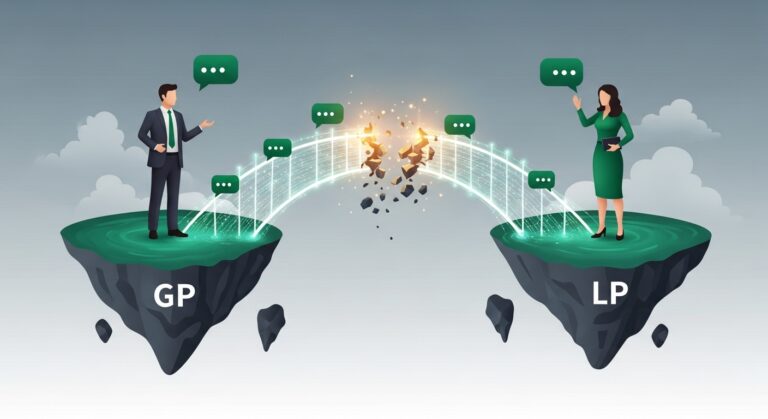
The Friction LPs No Longer Tolerate
Email-based fundraising still works. That is precisely the problem.
It works just enough to persist, but not well enough to meet how LPs now operate. Over the last few years, LP teams have become faster, more process-driven, and more selective about where they spend time. Their tolerance for fragmented communication, delayed responses, and document confusion has narrowed significantly.
What LPs increasingly experience during email-based fundraising is not failure, but friction. And friction, over time, changes allocation behavior.
How LP Expectations Have Changed in Private Equity
LPs today manage broader portfolios with fewer people. Internal finance and compliance teams are responsible for tracking commitments, reviewing documents, and reconciling information across dozens of managers.
As a result, expectations have shifted from “responsive” to “predictable.”
LPs expect:
- Immediate access to current and historical documents
- Clear visibility into what has changed and when
- Consistency across funds and fundraising cycles
Email-based workflows struggle to meet these expectations because access, version control, and response time depend heavily on individuals rather than systems.
Why Email Creates Transparency Gaps for LPs
Transparency is not just about sharing information. It is about how reliably information can be accessed.
In email-driven fundraising, LP teams often face uncertainty. Is this the latest deck? Did everyone receive the same update? Where is the final version of the PPM? Has anything changed since last week?
These gaps are rarely intentional, but they are unavoidable when documents are distributed across inboxes and follow-ups are handled manually.
This is where many firms begin centralizing LP access through an investor portal rather than relying on email as the system of record. Platforms such as Vantage Software allow firms to provide a single, controlled environment for LP communications and document access.
Speed-of-Response Has Become a Trust Signal
LPs interpret response time as a proxy for operational discipline.
When information is scattered across inboxes, even well-run teams struggle to respond quickly. Each request requires coordination, confirmation, and manual retrieval. Over time, this creates visible lag.
In contrast, when LPs can self-serve information through a centralized fundraising environment, response time improves by default. Firms that use a structured fundraising portal reduce the need for repeated follow-ups while maintaining partner-led communication.
Speed, in this context, is not about urgency. It is about reliability.
What Email-Based Fundraising Signals to Institutional LPs
Institutional LPs rarely comment directly on communication methods. They draw conclusions quietly.
Email-based fundraising can signal:
- Reliance on manual processes
- Limited visibility into LP experience
- Difficulty scaling operations
These signals matter more as LPs consolidate relationships and prioritize managers who are easier to work with operationally.
Firms that centralize reporting and LP access tend to reduce perceived friction, even when investment strategy and performance remain unchanged.
Internal link:
Why This Friction Affects Re-Ups, Not Just First Closes
LP dissatisfaction does not usually show up during a first close. It shows up during re-ups.
When engagement feels cumbersome across reporting cycles, capital calls, and updates, LPs quietly reduce allocations or deprioritize managers. The issue is rarely returned. It is an experience.
Email-based fundraising magnifies these friction points because it lacks consistency and auditability over time.
How Leading PE Firms Are Rethinking LP Communication
Leading firms are not abandoning relationships. They are redesigning the infrastructure around them.
By centralizing LP access, fundraising materials, and reporting in one environment, firms reduce dependency on email while improving transparency and speed. This shift allows teams to focus on LP engagement rather than coordination.
Many PE firms take this step when reviewing their broader operating model for private equity–specific workflows.
How Leading PE Firms Are Rethinking LP Communication
Leading firms are not abandoning relationships. They are redesigning the infrastructure around them.
By centralizing LP access, fundraising materials, and reporting in one environment, firms reduce dependency on email while improving transparency and speed. This shift allows teams to focus on LP engagement rather than coordination.
Many PE firms take this step when reviewing their broader operating model for private equity–specific workflows.