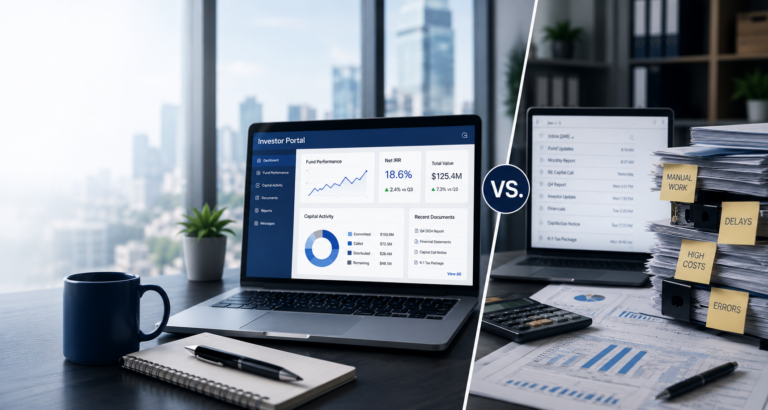
In the last decade, the private markets have experienced a dramatic shift in how capital is raised, monitored, and communicated. Venture Capital (VC) and Private Equity (PE) firms in the U.S. no longer compete only on performance. Increasingly, they compete on transparency, responsiveness, and operational efficiency, especially as institutional Limited Partners (LPs) demand more real-time visibility into their investments.
Against this backdrop, one category of technology has quietly evolved from “optional” to “expected”: the Investor Portal.
For GPs unfamiliar with it, an investor portal is far more than a file-sharing system. It is the digital home where LPs access documents, track performance, review capital activity, and engage with fund managers. But to understand why investor portals matter today, it’s important to first understand the problem they solve, the daily communication and reporting friction that slows fundraising and frustrates LPs.
Why Traditional GP/LP Communication Breaks Down
For many U.S. VC and PE firms, communication still relies heavily on emails, spreadsheets, static PDFs, and outdated data rooms. These tools were never designed to handle institutional relationships involving dozens of LPs, multiple funds, side letters, and increasingly complex reporting.
Throughout a fund’s lifecycle from fundraising to deployment to exit, information moves constantly. When this flow relies on manual processes, friction is inevitable. Emails get buried. Different versions of quarterly reports or financials get shared by mistake. LPs ask for the same files repeatedly because they can’t locate the correct one. When GPs are forced to resend materials or clarify inconsistencies, operational efficiency drops and LP confidence weakens.
The issue has become so common that institutional LPs now cite “delayed reporting” and “scattered communication” as top frustrations when interacting with GPs, according to ILPA studies. The problem isn’t lack of effort from IR teams; it’s the lack of an integrated communication infrastructure.
This is the gap that investor portals fill.
What Exactly Is an Investor Portal?
An investor portal is a secure digital platform designed to centralize all investor-facing communication, reporting, and document access. Instead of sending files over email or updating multiple spreadsheets, GPs upload information once, and LPs log in whenever they need it. The portal becomes a living, always-current hub of information.
While each platform differs in its features, the core purpose is consistent:
Give LPs one reliable place to view everything related to their investments.
This includes capital calls, distribution notices, fund financials, quarterly letters, K-1s, performance dashboards, portfolio updates, fund documents, and historical reports. Portals also support compliance expectations, with secure access controls, audit logs, version history, and encryption standards that meet institutional requirements.
Why Investor Portals Matter in 2026 for VC & PE Firms
1. LP Expectations Have Changed
Ten years ago, most LPs accepted emailed PDFs and occasional updates. Today, they expect a digital experience comparable to online banking, one with real-time access, consistent communication, and intuitive navigation. LPs managing dozens of relationships cannot afford to dig through inboxes for capital account statements or run their own manual trackers.
Institutional investors now expect GPs to provide seamless digital access. Investor portals bridge this expectation gap.
2. Reporting Complexity Has Increased
Private funds are no longer simple “black boxes.” LPs expect:
Performance details
- Portfolio company metrics
- ESG reporting
- Updated valuations
- Capital account summaries
Producing and distributing this information manually increases the risk of errors and inconsistencies. Portals standardize reporting, reduce human error, and make it easier to deliver ILPA-aligned updates. This also helps firms remain compliant with evolving SEC expectations around disclosure and recordkeeping .
3. Fundraising Requires More Professional Infrastructure
The U.S. fundraising landscape is competitive. LPs compare not only track records but also a GP’s operational maturity. Emerging managers, especially, must demonstrate that they have institutional-ready systems. A well-structured investor portal signals professionalism, discipline, and reliability, traits LPs favor during diligence.
Preqin’s 2024 Private Capital Report notes that LPs increasingly prioritize managers with stronger reporting and digital capabilities. A portal enhances that perception.
4. Multi-Fund Management Has Become More Complex
Most established VC and PE firms run multiple funds simultaneously. Without a centralized system, managing communication across Fund I, II, III, parallel vehicles, co-investments, and SPVs becomes overwhelming. Investor portals simplify this by giving each LP a single login with access to all the funds they participate in.
5. Efficiency Gains Reduce IR Team Burnout
Investor relations teams face tremendous pressure during quarterly reporting, fundraising cycles, portfolio updates, and audit periods. A significant portion of their time is spent answering repetitive questions, hunting for documents, or updating spreadsheets. A portal reduces this “busy work,” allowing IR teams to focus on deeper engagement and strategic LP conversations.
How Investor Portals Directly Improve LP Experience
LP experience has become a major competitive differentiator in private markets. Portals enhance that experience in several ways.
First, portals offer transparency. LPs can see capital activity, performance data, and important fund information whenever they choose, instead of waiting for email updates. Transparency builds trust, and trust strengthens re-ups.
Second, portals support self-service access. LPs can download historical financials, legal documents, or K-1s instantly. This eliminates the need for GPs to resend files and reduces turnaround time.
Third, portals give LPs confidence that the information they are viewing is current. Because everything is centralized, there is no confusion over which version of a report is correct.
For LPs, this level of clarity and access is invaluable.
The Compliance and Security Advantage
Cybersecurity is no longer a background concern, it’s a board-level priority. Email-based communication exposes GPs to risks ranging from phishing attacks to unauthorized access. Investor portals use encrypted infrastructure, controlled permissions, and multi-factor authentication to safeguard sensitive financial data.
This matters because the SEC has amplified expectations around private fund cybersecurity and disclosure. Having an investor portal with audit trails and version history helps satisfy compliance readiness and reduces the risk of operational lapses that could trigger scrutiny.
Why Investor Portals Are Becoming Standard in the U.S. VC & PE
The private markets are moving toward digitization. The best-run firms, from $100M emerging managers to multi-billion-dollar buyout funds, are prioritizing investor portals for three core reasons:
- They improve LP satisfaction and retention.
- They reduce operational inefficiency during fundraising and reporting.
- They demonstrate institutional-grade readiness to new LPs evaluating the GP.
In a landscape defined by rising expectations, tighter regulations, and increased competition for capital, the firms that modernize their investor communication infrastructure gain a tangible advantage.
Investor Portals Are Now a Foundation, Not a Feature
An investor portal is more than a tool, it is the backbone of modern investor communication. It ensures that LPs consistently receive the transparency, accuracy, and responsiveness they expect. For GPs, it reduces operational stress, eliminates version chaos, and elevates the firm’s professionalism in the eyes of investors.
As VC and PE firms across the U.S. navigate increasingly complex fundraising environments, the question is no longer whether to adopt an investor portal, but when.
LPs expect it. IR teams need it.
And fundraising is demonstrably smoother because of it.
If you’re ready to strengthen LP communication, simplify reporting, and operate with greater transparency, the next step is exploring an investor portal built for modern private markets.
Discover how Vantage transforms the entire GP–LP experience from fundraising to reporting — with a secure, intuitive platform tailored for the U.S. VC and PE firms.