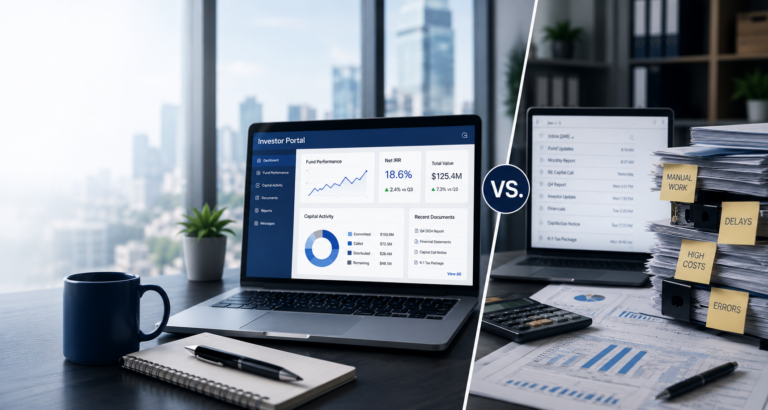
Investor relations has emerged as one of the most strategic functions inside a private equity or venture capital firm today. LPs expect increased transparency, quicker response times, and deeper access to fund performance than ever before. With reporting cycles tightening and fundraising becoming increasingly more competitive, General Partners are turning to investor relations software to keep pace.
But choosing the right platform is not straightforward: the wrong system can slow down reporting, confuse LPs, or create even more fragmentation than before. The right one becomes the operating backbone of fundraising, reporting, communication, and long-term relationship management. This is what GPs need to know before making a decision.
Understand the real problems you're trying to solve.
Every firm starts its search with a different set of frustrations. Some are overwhelmed with quarterly reporting. Others are struggling with chaotic investor communications, outdated spreadsheets, or a growing mix of funds and SPVs. Before evaluating features, GPs need clarity on what is breaking inside their current workflow.
The most successful firms treat IR software not as a tool purchase but as a structural fix to inefficiencies that have been building up throughout the years.
Software must scale with your fund structure
No GP is going to remain at the same AUM forever. Whether you’re managing 10 million or 10 billion, your IR stack must adapt to multi-fund, multi-entity complexity. As you raise new vehicles, onboard new LPs, and evolve your reporting style, that platform should grow without requiring you to redesign everything from scratch.
This is often where older or generic systems tend to fall short. The most capable modern portals are handling different funds, SPVs, permission layers, and reporting needs within one ecosystem without making internal teams maintain parallel workstreams.
Security and compliance cannot be an afterthought.
Modern LPs are more concerned about data privacy than ever, and sensitive documents, capital account details, and performance datasets need to be safeguarded with bank-grade security.
The right IR platform brings SOC-2 compliance, permission-based access, encrypted storage, activity logs, and controlled data rooms built to withstand institutional scrutiny.
A single misstep in security could irreparably damage GP-LP trust. Getting this right from day one is paramount.
Modern LPs want real-time insight, not PDF dumps.
The industry has moved far beyond static quarterly packets. LPs want interactive dashboards, drill-down analytics, transaction history, distribution timelines, and views that reflect real-time fund performance.
A truly modern investor portal serves to extend your philosophy on transparency. It helps LPs understand your strategy, not just your numbers. It reduces the repetitive back-and-forth that IR teams deal with every reporting cycle.
Fundraising and investor relations should live in one system.
Today, most GPs prefer one unified platform for bringing together CRM functions, fundraising pipelines, VDRs for due diligence, communication logs, and investor reporting. When those workflows sit in different tools, teams spend more time reconciling information rather than managing the relationships themselves.
A connected system keeps everything about each investor in one place: their commitments, communication history, the level of interest, and performance inquiries. This continuity often accelerates fundraising cycles.
Ease of use determines adoption.
No matter how powerful the software may be, it will fail if the experience feels heavy. Both GPs and LPs covet simple, intuitive, and modern interfaces. If LPs can log in once and, right away, understand everything and find the information they want without assistance-you have already won half the battle.
A clean experience is not a design luxury. It directly strengthens investor confidence.
Reporting Automation Should Remove Manual Burden
Even the most effective IR teams spend countless hours formatting reports, preparing capital account statements, distributing updates, and re-checking calculations. The right software greatly reduces this effort, not by adding automation for the sake of technology, but by standardizing reporting logic in a way managers can trust.
Good automation frees your team to pay attention to relationship management instead of paperwork.
Your IR Platform Must Fit Into Your Existing Tech Ecosystem
A modern GP will rarely work with just one tool: accounting systems, portfolio management tools, CRMs, email platforms, and analytics tools all fit into the mix. Your investor relations system must integrate well with them.
Disjointed platforms create new data silos, defeating the purpose of upgrading your IR infrastructure.
Choose a Vendor With a Future, Not Just a Product
The final factor is often overlooked. Investor relations software isn’t a one-year decision. It’s the digital spine of your firm. It matters what the vendor’s roadmap, client base, support culture, and ability to innovate are as much as the product itself.
You are not just choosing software, you are choosing a long-term partner.
Bringing It All Together
The right investor relations software strengthens transparency, accelerates reporting, simplifies fundraising, and enhances the entire GP-LP relationship cycle. In return, it gives LPs the confidence they expect and GPs the operational backbone they need to scale.
Well-chosen, the platform becomes a strategic advantage; poorly chosen, it is only another system that your team works around instead of with.
Looking for a Modern, All-in-One Investor Portal?
First Rate Vantage unifies fundraising, reporting, performance analytics, and investor communication into a single, holistic ecosystem for both the emerging manager and the established asset manager. Whether you manage 10M or 10B, Vantage adapts to your structure and elevates your LP experience from day one. Book a demo and see how modern investor relations should work.